

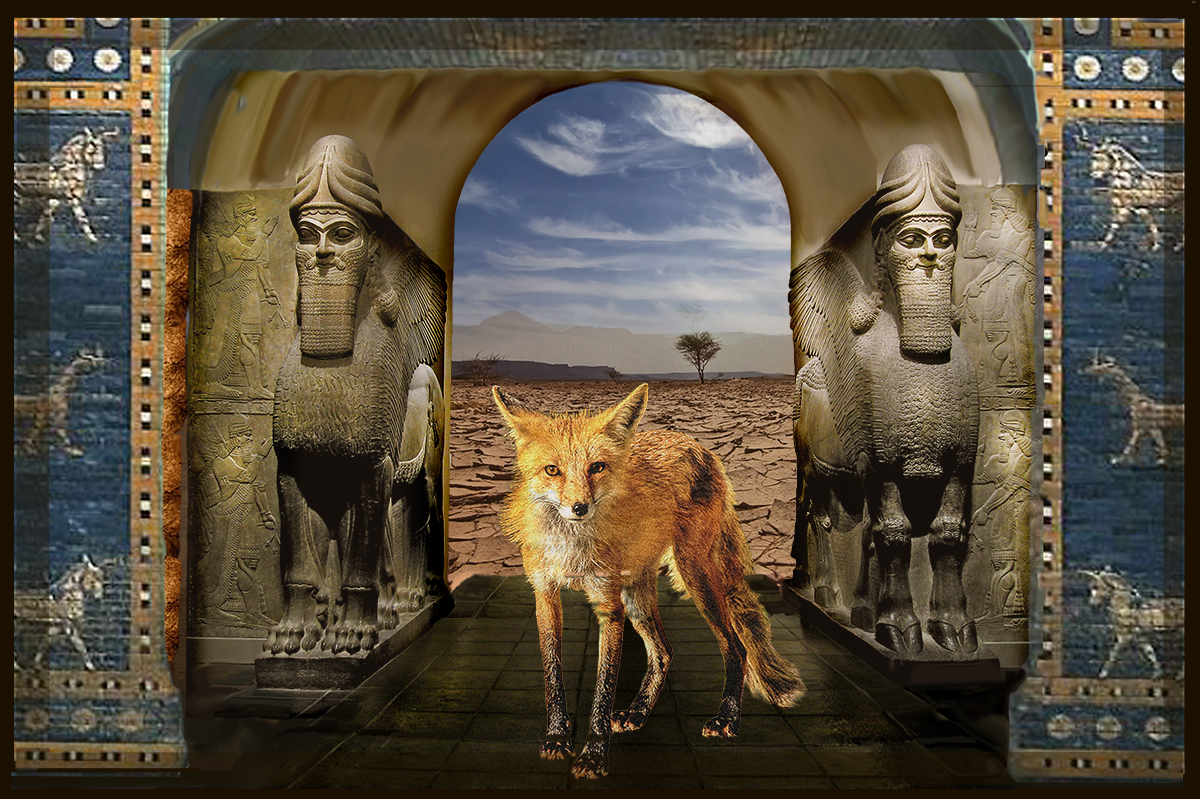
The Fox’s Bargain
Benjamin Adams
No prophecy had warned of the disaster that befell Ashur. When the last rain had fallen, the city watched with hollowed eyes as its life leeched away grain by grain. The dry fields split into a puzzle of cracks. Human and animal choked on dust. Each brass-colored dawn revealed knots of dead huddled in doorways and beside empty wells. The river, once a blue crescent circling gently round the city, was filled now only with the wind’s dry shriek.
For time out of mind the people of Ashur had trusted the slow pulse of the Tigris, the staccato thunder of spring storms, and the variable temper of Ishkur, who governed them both. But the storm god had vanished. Some said Ishkur had been killed by a rival god, a god of dust and stone; others said he had abandoned Ashur for a younger, more prosperous city across the desert. The priests feared he had been seized by some ancient thing older than the god himself, and dragged down the spiral root into Kur.
At the palace of the gods, there was no one to wash its steps or sweep its halls. Within, the gods held funereal council, presided over by Enlil, lord of the sky. Older than the oldest brick in Ashur, his beard, once white as new salt, hung dull and tangled, his eyes rimmed red as pomegranate rind.
Suspicious that Enlil was up to his old tricks of winnowing down the human numbers, the other gods eyed him askance as they argued about what to do, trading accusations and circling round the real cause. The goddess of the harvest, gaunt and sere, and the cattle god, ribs visible beneath a thin robe, blamed the river spirit for abandoning its course. The river spirit howled dust at them. Nergal, the dark prince with teeth filed to points, smiled hungrily at his fellow gods.
Enlil listened as the last of his patience faded. “Enough,” he rasped. “We all know Ereshkigal has taken my son, and with him the rain, and so the world is withering. I have sent seven envoys down into Kur to retrieve him. None have returned. Who is there to descend into Kur and free Ishkur from the house of death?”
But no living thing entering Kur had ever come back out. So the gods looked away and sat silent amidst echoes and keening wind.
“Then I will go myself,” Enlil said softly.
Rising over the soft sounds of surprise, a voice piped up from the far end of the room. “Excuse me, Great Lord, there is me. Not one of you, but willing to go.”
A lean, rangy creature stood up on his hind legs and padded forward. Fox fur both sleek and ragged covered him, as if stitched together from a thousand storied pelts. His too-large ears peaked in ragged points, and his tail was a sparse thing, like a brush for cleaning out old chimneys. Yet he held himself with an easy dignity, and his eyes, yellow and rimmed with black, glinted.
“I have gone by many names, but you may call me Fox.”
Lahar, protector of flocks, snorted. “We cannot trust your kind. You steal the eggs from the nests and the grapes from the vines. Your bargains conceal tricks.”
But Dumuzi leaned forward. “Let him go, father. The farmers and shepherds have nothing left to steal.”
Enlil regarded Fox. “How would you succeed when all others have failed?”
Fox tilted his head. “I am neither god nor mortal, and can slip between the rules of Kur. I’ll find your son and bring him back. Or fail so epically you will be appeased for whatever days are left to you.”
The silence grew thin and uncomfortable. Finally, the father of gods nodded. And the world, half dying, felt the decision settle into place.
“It is done. Bring back my son, alive and well. Take whatever you need.”
Fox bowed and smiled “My only need is the promise of a good welcome if I succeed, and a suitable eulogy if I fail.”
With a flick of his ruined tail, Fox sauntered out. Out in the sun-bleached city, he padded on all fours past the dead and the dying, past doors sealed with clay. At the eastern gate, he stopped and looked back. The city shimmered in the heat. Before him, beside the dried snakeskin of a riverbed a girl sat, seeking some slight moisture beneath the cracked surface. She gazed at him wonderingly. Fox winked, and a smile crossed her dust covered face.
He turned to the wide eastern plain, and set off. He kept a steady pace. The city gradually vanished behind him, until the world became nothing but empty steppe and sky. Grass crackled beneath his paws. The wind smelled of nothing and even the carrion birds deserted the sky.
Under the fire of the sun and the cool of the moon Fox moved on, head low and tail limp, until he reached the far edge of the world, where the horizon dipped into itself. And there, Fox came upon the entrance to Kur. An open mouth in the earth, black as pitch, rimmed with fine gray dust that hung in the air, marked only by a pair of stones—one worn smooth as if by the passing touch of endless hands, the other sharp and wet-looking, as if it had only just pushed up out of the soil.
Out of the dimness two figures stepped, tall as priests, faces hidden beneath tattered veils of yellowed gauze. They wore horned caps and each held an axe and a mace. Their bodies were draped in ancient wedding veils, crusted with dust and pollen and the salt of long dried tears. Their teeth bared with each breath and clacked like bones strung on a cord. One kept its eyes shut; the other had eyes so pale they seemed no color at all.
Fox bowed low. “I seek to enter Kur.”
The guardians answered as one, their voices dry as desert wind. “All who enter must eat. All who drink must stay.”
Fox nodded.
One guardian held out a small portion of bread, mottled and rough, speckled with seeds. The other offered clear cold water in a tiny clay jug.
The guardians spoke in unison. “Bread binds the body to the earth. Water binds the soul to Kur. Eat, drink, and enter. Or turn back and do not return.”
The bread’s scent was of dust and faint sweetness, like the memory of fruit from a tree that never bore. Fox pretended to eat, but hid it in his ragged pelt . The water he raised to his lips, but let it soak down through the fur of his chin. He plugged the little jug and slipped it beside the bread.
The guardians stood aside and silently looked down as Fox slipped between them and down into the darkness. He rolled in the dust, and dragged himself to Neti, Kur’s gatekeeper. Neti thought little of this pitiful corpse of a fox, and let him slink through the first of the seven gates.
Down long steps, down, through dust and mold and the peppery scent of rot and trackless time. Pale light came from nowhere, and the low ceiling was of packed gray dust. As he went lower, the air grew thicker. His limbs grew heavy, his head dizzy.
Tunnels forked and looped, the walls were woven with roots bleeding thin red sap and smelling sharp as iron. Fox sought other scents — of storm clouds and bruised lilies, scents belonging to Ishkur.
Curled in hollows along the passages were children who had died in the famine, never brought before Erishkegal to be pronounced dead, held halfway between realms. Pale and thin, they nestled along the walls. Each clutched a stone they turned over and over as if asking for answers. The only sounds was the slow, soft rubbing of palms over stones and, from deeper down, the distant rumble of a storm behind stone walls.
Fox shivered but did not stop. For seven nights he crept deeper into Kur. At each gate he poured a few drops of water from the jug onto the gate latch, and it would fall open.
Sometimes the tunnels stretched, empty and wind haunted, sometimes they cinched tight enough to squeeze breath from his chest. Fox passed rooms heaped with crowns, and sometimes rushing through the halls were their former wearers, now bearing messages or food and drink to serve netherworld gods.
Fox skirted the last gate. He knew beyond it lay the heart of Kur, the palace of Erishkigal, encircled by the garden of the sun-god Utu. When Utu passed over the garden, he brightened the shining trees with their fruit of gleaming precious gems, while the world above darkened,
The scent of storm grew strong now, and Fox followed it to the room holding Ishkur. The god was stripped of his sky-blue robes, beard caked with salt, limbs bound with thick, twisted vines. His eyes glowed in the dimness, one bright and alive, the other milky white.
Ishkur turned his good eye. “I felt you making your way here little Fox.”
“I’m here to free you.”
“In Kur, nothing goes free. Ereshkigal holds all. You have seen the children?”
“Yes. They break my heart.”
“They have died because of the famine. Because I am imprisoned here. My sister knows she brought their deaths upon them but has cold ideas of how to comfort.”
“Then we take them with us. Stay still while I chew through your bonds.”
Ishkur shook his head. “Releasing me will raise the alarm, and without my cloak, my thunder, my cattle, I cannot bring the storm. They must be found first.”
“Then I will find them,” Fox said, and slipped back into the shadows.
He followed the god’s scent, held in his cloak, of rain and wet earth and the bright sharpness of lightning striking sand. It was faint here, but Fox had tracked fainter trails across wastelands and through the dreams of sleeping kings. The scent led him deeper into Kur, down corridors that twisted like intestines and dripped with red sap.
The walls pulsed, and the floor was soft underfoot, yielding like flesh. Fox passed chambers filled with impossible things: the discarded names of the forgotten dead, written on strips of bark that crumbled at a breath; a pool of black water that flowed upward into the ceiling and vanished into stone; a room where voices argued in languages dead before the first city rose. Fox averted his eyes, passed them all, and followed the scent.
At last, he came to a chamber door of woven bone, intricate as lace, hinged by sinew twitching with phantom life. Beyond it, Fox could smell storm and cattle and the particular blue darkness of sky before rain. Two guards stood before the door— creatures ancient and deliberate. They were shaped like women, but their skin was the gray of old ash, and their hair moved in a windless wind, coiling and uncoiling like serpents tasting the air.
Fox approached with head low and tail dragging. “The Queen requires your presence. I am to stay here until you return.”
The guards regarded Fox with eyes that held no pupils, only a flat, reflective shine like polished coins. “The Queen sends no messengers like you,” said one, her voice the sound of grinding stone.
“She sends what she pleases when she pleases,” Fox replied. ” I will tell her you chose to turn me away rather than obey her.”
The guards communed silently, their serpent hair touching. Finally, they turned and left, trailing smoke and dust.
Fox rushed to the door. It had only a latch of carved bone shaped like a hand. He lifted it and slipped inside.
The chamber beyond was vast and cold, its ceiling lost in darkness. It was piled with the treasures mortals and gods had gathered in life and thought they’d keep when they passed into Kur. Crowns of gold, staffs humming with dormant power, sandals waiting to carry their wearer across water, and, shimmering even in the pallid light of the netherworld, Ishkur’s sky-blue cape. Folded in its pocket, both sound and substance, Ishkur’s thunder crackled.
Close by, penned in a circle of salt, stood seven cattle, cows the white of white birds, cows the brown of cedar wood, cows the black of kohl reed, multi-colored cows, cows the grey of storm clouds. Eating the parched grass of Kur. They lowed softly when they saw Fox.
Fox draped Ishkur’s cape across his shoulders and it settled over his ragged pelt. The world shifted. Though the cattle knew better, in seeming, he had become Ishkur, storm god.
Fox grinned beneath the disguise. He spoke to the thunder in the language of weather, and the thunder, curious about this strange creature wearing its master’s cape, condensed into a humming sphere no larger than a pomegranate. Tucked softly into a fold of the cape, the sphere’s vibrating warmth and aliveness held within it the violence of a tempest.
The cattle stamped and snorted. Fox spoke to them in the language of beasts. “We will free your beloved Ishkur, so that green fields and rain will return. Fresh water will fill the rivers again.” He broke the circle of salt, and they stepped out, docile as lambs. “But we have little time, so kindly allow me to sit upon one of you and guide your way.”
A bull, horns curved as the crescent moon, shoulders broad as doorways, voice the low rumble of distant thunder, came forward.
Fox jumped lightly to the bull’s broad back. The cape billowed around him, and in the dim netherworld, the trickster looked like a god. The other cattle fell in behind them. Their hooves struck the stone floor and raised the dust of millennia, yet made no sound. They moved quickly, yet time stretched out around them. The only sound was their soft lowing and the drip of red sap from the bleeding roots and the distant rubbing of stones turning in small hands, until time snapped back and they entered the chamber where Ishkur was bound.
“Quite an entrance,” the storm god said, his voice faint.
Fox grinned, ran to Ishkur, and set to chewing through the twisted vines that bound him. They tasted of mold and disease, and Fox gagged, but he worked quickly, with teeth and claws. When the last strand snapped, Ishkur fell forward.
Fox draped the sky-blue cape around the god’s shoulders. It settled on his frame and color began to seep back into his face. Reaching into the folds of the cape, Fox withdrew the humming sphere of thunder. He held it out to Ishkur.
The god folded his hands around it, and light shot out brightly through the gaps between his fingers. The sphere flickered, rumbled, crackling with barely restrained energy, filling the air with the taste of copper and ozone. Ishkur rose to his knees, then to his feet, swaying like a reed in wind. The salt fell from his beard. His clouded eye began clearing.
The sound of slow, deliberate applause echoed heavy as lead through the chamber.
At the entrance, shadows gathered into something solid and terrible —Ereshkigal, Queen of Kur, taller than any mortal, warping the very substance around her until the stone walls bent toward her. Hair moved like dark smoke around her face, half luminous as carved ivory, half shrouded in shadow deep as the void.
She wore robes woven from the gray dust of forgotten tombs, brown minerals from earthen depths, and the green of old copper. At her throat hung a necklace of small bones, each carved with a name that had been struck from the records. Her hands, pale and long-fingered, gave off waves of power as she clapped, each strike like the closing of a coffin lid.
Flanking her were the guards from the treasure chamber, their hair coiled tight against their skulls, their expressions dangerously blank.
“Well done,” Ereshkigal said, her voice honey over broken glass. “A performance worthy of the old songs.”
She descended the steps into the chamber, and with each footfall, the temperature dropped. Fox’s breath misted the air. The Queen of Kur, her eyes, ancient, penetrating thought and soul, bearing down upon him, were filled with amusement and rage. “Tell me, little fox-who-is-not-a-fox, did you truly believe I would not notice an intruder? Did you imagine my guards so foolish, my attention so easily diverted?”
Fox’s tensed for a blow, but Ishkur placed a hand upon his shoulder. The storm god stepped forward, jaw set and eyes crackling. “Sister!”
“Brother,” Ereshkigal turned and smiled a terrible smile, beautiful as a blade. “You must be missed above. Does father still sit at his empty table, mourning his favorite son?”
“Think what your games have cost the mortal realm.”
“Games?” She tilted her head,. “I play no games, brother. You entered my domain of your own foolish will, chasing a petty slight from Nergal, who baited you with false words. I simply held you to the laws of Kur. All who enter must stay. You know this.”
Fox stepped forward, softly, his ruffled fur standing on edge. “Let us bargain, Lady of Shadows.”
“Bargains are the bones of the dead,” said Ereshkigal. “What will you offer, fox, that I have not taken from a thousand heroes?”
Fox forced himself not to freeze, not to blink. He thought. “All gods hunger for worship. Release us, and I will be your herald—I will sing your name across the lands.”
She tilted her head further, slow as a snake. “Songs disappear with the wind.”
“But wind brings life-giving rain. I will make your name the life and storm of every hearth. The living will bow their heads to hear it, and the dying will hope to meet you gentle.”
“You think I would release you for that?”
Ishkur looked his sister in the eye, a gleam of blue now unclouded in his gaze. “I think,” he said, “that you want the world to survive. Otherwise, who will remember you, when all is bone and dust?”
Ereshkigal laughed, and it was not a pleasant sound. “Mortals forget everything. Even the gods.”
Fox stepped closer. “Let us go, and I will tell everyone of your power, your cleverness. You will be a name on every tongue, a fear in every lullaby. The mortals will know your worth, and the gods will envy you.”
Ereshkigal waved one pale hand dismissively, and the gesture carried the weight of eons. “Fear and respect I have in abundance, little fox. The dying whisper my name with trembling lips. The gods speak of me in hushed tones thinking I cannot hear. Every soul that enters my domain knows my power before they cross the threshold. Your offer is old bread.”
She raised her hand to sweep them all down.
Fox’s ears flattened against his skull. The cattle snorted, sensing the turning of fate. They shifted, their hooves scraping stone, and in the distance came the soft sound of children endlessly turning stones. Fox’s ears shot forward again.
“How many songs,” Fox asked, his voice quiet now, stripped of performance, “do they sing of your mercy?”
The Queen of Kur went very still. Even her serpent-haired guards froze, their coils halting mid-undulation.
“How many tales,” Fox went on, “celebrate your kindness? How many mothers invoke your name in hope? How many children go to sleep hearing stories of Ereshkigal the Gentle, Ereshkigal the Compassionate, Ereshkigal who showed mercy when mercy was not required by law or custom?”
Something flickered across her face, something raw that lived where loneliness and longing tangled like roots beneath stone. Fox’s sharp eyes caught it,
“Release your brother to the world above,” Fox said softly. “Let the children you hold here—these innocents who died through divine conflict, let them pass on to the peaceful spirit realm where they need not turn stones for eternity. Allow that all future children who die before their time, through famine or flood or the wars of gods and men, be granted the same mercy. Let them rest in peace rather than labor in darkness.”
He paused, and the netherworld held itself still. Even the bleeding roots paused.
“Do this,” Fox said, “and I will sing of your mercy, throughout the realms of gods, mortals, and the between worlds. They will all know that Ereshkigal the Terrible is also Ereshkigal the Merciful. That the Queen of Kur knows not only law but compassion. That she grants innocence sanctuary. Mothers will bless your name when their ill children recover. The dying will face you not with terror, but with the hope that you might show them the same grace you showed the innocent.”
The smoke thickened around her. She bent to look Fox in the eye. “You play a dangerous game.”
“I always have,” said Fox, and grinned tentatively.
Her face hardened. “And death comes even to the more-than-mortal Fox. Then what of your bargain?”
Fox gulped. “Stories,” he replied, “are things that outlast even death. I will sing songs so strong that when my voice fails the songs will carry on.”
She straightened and exhaled swirling dust, smoke, and death. “Go. All of you,” she said sharply. “Quickly. Before I change my mind. But remember: the dead are mine. If you cross me again, there will be nothing left for you above or below.”
Fox did not wait. He turned on his heel. Ishkur nodded to his sister and turned, sky-blue cape sweeping around him, thunder safely against his chest. The seven cattle fell in behind their master, and as the procession passed the winding, twisting halls, each pale child, their wide eyes blinking, waking, one by one set down their stones, rose up, and followed.
They moved through the seven levels of Kur like a river flowing back to its source, upward against the natural order of things. The bleeding roots of the tunnel walls withdrew their tendrils as the group passed, curling back into the stone.
They tread the gardens of rust, and the flowers bloomed in reverse, petals folding inward and disappearing into buds. The rivers that flowed uphill rushed downward. The mounds of sea creature shells trembled as they passed, or collapsed into powder smelling of brine and ancient seas.
Ishkur walked beside Fox, his strength returning with each step. The storm god’s beard was regaining its luster, black shot through with silver like rain clouds lit by lightning. His eyes, sharp and bright as polished bronze, crackled with energy, and Fox could feel pressure building around him—the god’s power unfolding itself after the long captivity. The cattle sensed it too, and they walked with their heads high, their eyes no longer white-rimmed with fear but bright with anticipation.
The children followed in silence, their small feet making no sound, their bodies casting insubstantial shadows. Passing each gate the thick air thinned further, and the sourceless pallid light gave way to something warmer. The ceiling lifted, the walls drew back, and Fox welcomed the smell of the world above, withered and drought stricken as it was. Dust and heat and the sharpness of dying grass.
Kur’s entrance appeared ahead, a circle of harsh brightness after so long in the netherworld’s twilight. The guardians stood aside, nodding as the group passed the stones that marked the entrance.
They emerged onto the brown hillside, into the mortal world. The air hit them like a wall, hot and dry and tasting of dust and dying grass, but after Kur, as good as wine. The cattle burst into the open bellowing cries of relief, scattering across the withered hillside.
“Brother Sky,” the storm god whispered. “I have returned.”
The children first stood clustered at the threshold, uncertain, eyes closed against the brightness. Slowly, they opened eyes no longer vacant and scattered across the dying landscape, pouring from the entrance like water, their pale forms bright against the brown hillside and yellowed grass.
And as they went, in the wind of the land of the living, as they tasted air hot and dry but alive with the promise of storms to come, they began to fade, their edges softening until they looked like morning mist. They were free.
Fox and Ishkur began the long trek home, and the sky began to darken. The first drops of rain fell, each raising a puff of dust. The cattle bellowed and Ishkur smiled.
Fox walked nose to the wind, composing stories.
That night, while the gods celebrated, and the mortals gave thanks and set out buckets and barrels to catch the rain, the city of Ashur shifted its shape. To the east stood a new temple, a seven-storied temple of dust, and small stones, and roots, and the briny shells of sea creatures. Not built, not planned, not grown. But there.
Atop the temple, in the wet darkness, Fox sat on his haunches and regarded the world. His fur was damp and clung to him in patches. But he was content, and his tail, thin and frayed as old rope, twitched with satisfaction.
He licked the rain from his whiskers and tipped back his head. The sounds that rose from him were between animal and divine—sharp, keening, carrying through the night.
He howled the story of the city, of the drought, of his journey, of the return of Ishkur. He told of the old world, and the bargain struck in darkness far below; of the children who turned stones in the tunnels of Kur. He sang of loss, of survival, of debts paid, and promises kept. But above all, he sang of Ereshkigal the Merciful, Queen of Kur, so that no one in Ashur—or anywhere touched by rain—would forget.
Fox watched the city mend, the children grow round and strong, the gods grow content and create anew as the world righted itself.
Sometimes he walked among the people, his tail a little fuller, his step a little lighter. Sometimes he curled atop the temple at the city’s edge, and slept the sleep of one who has kept his bargain.
And sometimes, when the moon was low and the wind carried the smell of wet earth, he would tilt his head back and let fly a howl that reminded the city, and himself, that nothing lasted forever—not the reign of gods, not the hold of the dead, not even stories.
THE END
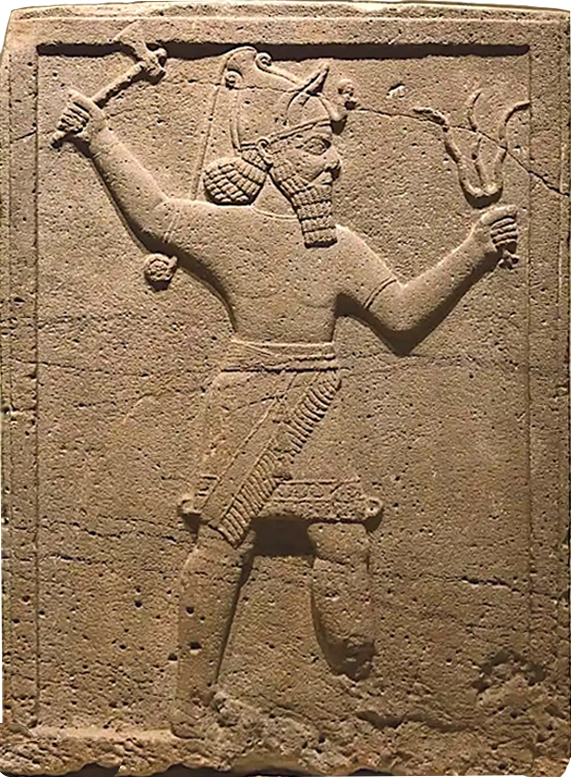
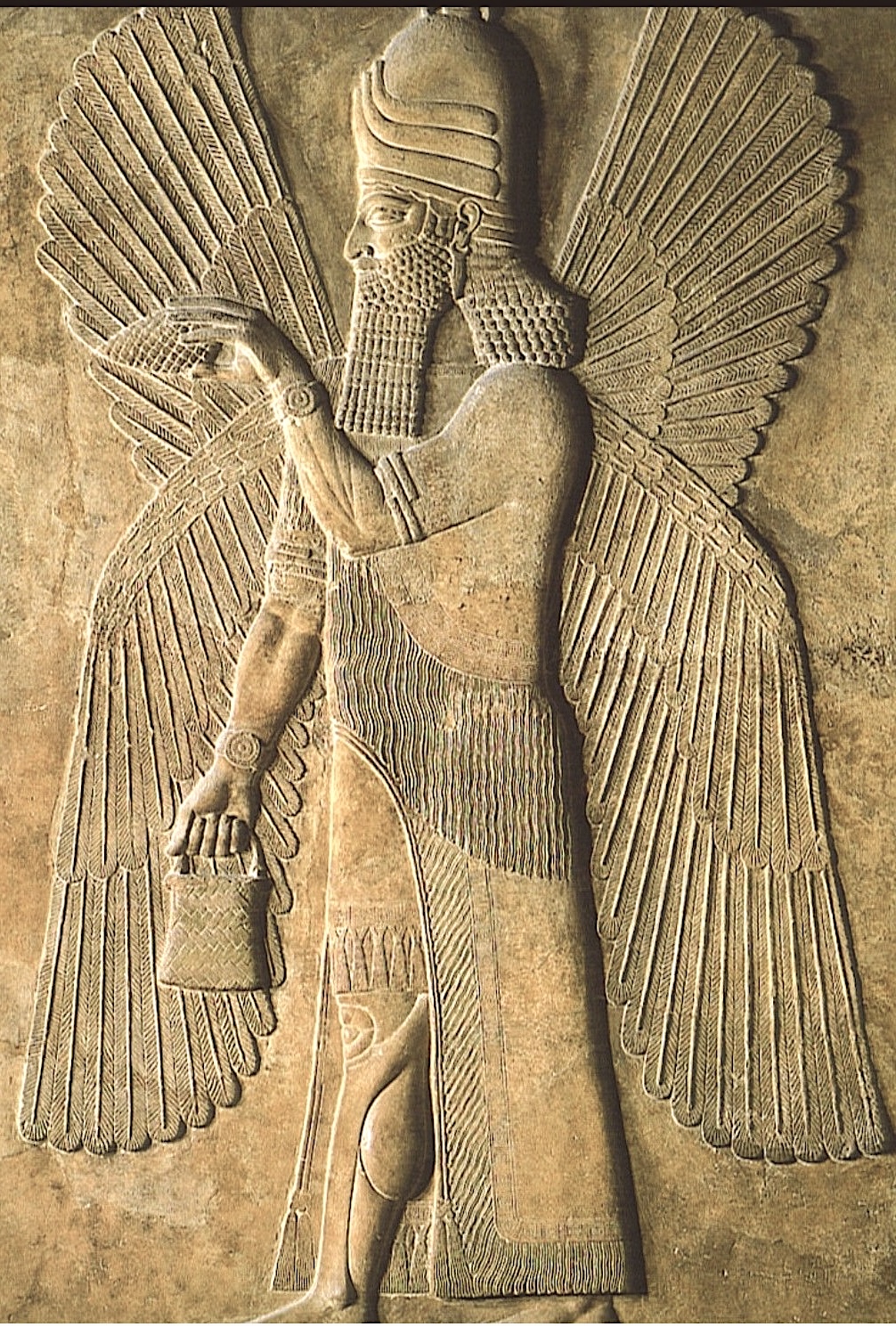
“The Fox’s Bargain “, © Benjamin Adams, first published here in Cosmic Roots & Eldritch Shores, October 16, 2026
Benjamin Adams was a 2002 Bram Stoker Award nominee for co-editing the anthology THE CHILDREN OF CTHULHU. He has also written professionally for Doctor Who, in the Big Finish anthologies SHORT TRIPS: SNAPSHOTS and SHORT TRIPS: THE CENTENARIAN. Other 2026 appearances include stories in INTO THE DEEP, DARK WOODS (WordFire), SUMMER IN THE CITY (Ruadán), and DREAMS DIVINE (Flame Tree). Most recently, he has sold a Carnacki/Sherlock Holmes crossover to Belanger Books for their anthology THE DETECTIVE AND THE GHOST-FINDER. His stories generally deal with grief, love, pain, and trauma, although sometimes they’re just about monsters.
This story is based on a Mesopotamian legend that has only this past year been translated into English. Some of the original is missing, and the author hopes that it has not been hubris to compose an ending for it!
Illustration by Fran Eisemann, using public domain stock and stock provided by Omnia.
You can comment on this story and artwork at The Forums, on our Twitter page, and our facebook page. and our blusky page
You can Subscribe to one of our sliding scale subscriptions to receive notifications of future publications, and to help us bring you more stories, artwork, podcasts, and articles.