

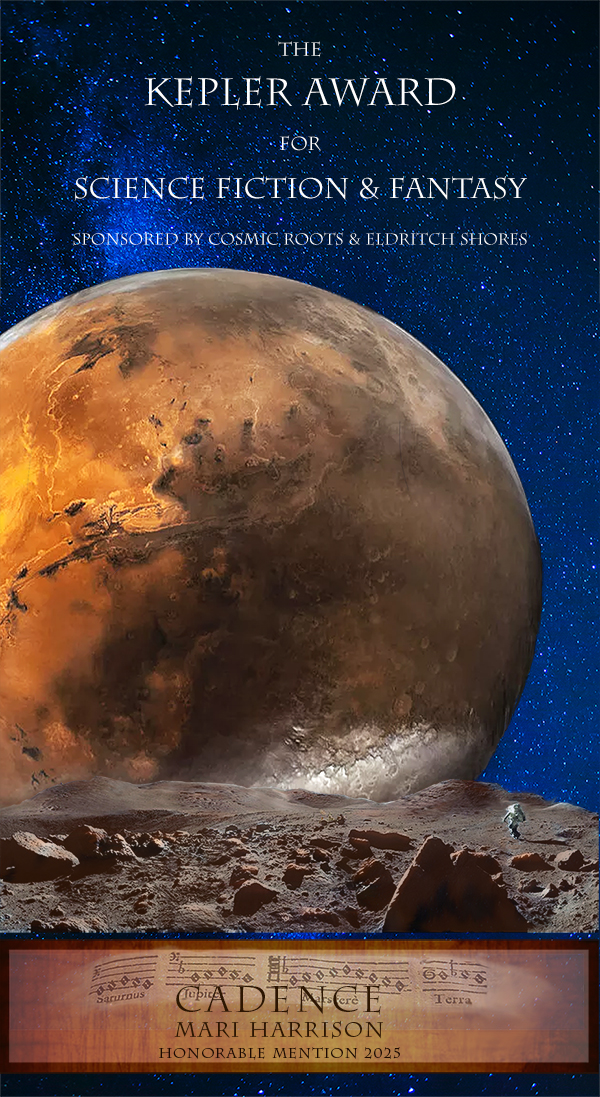
Cadence
Mari Harrison
— “Limtoc research station to Arcadia Planitia Central.”
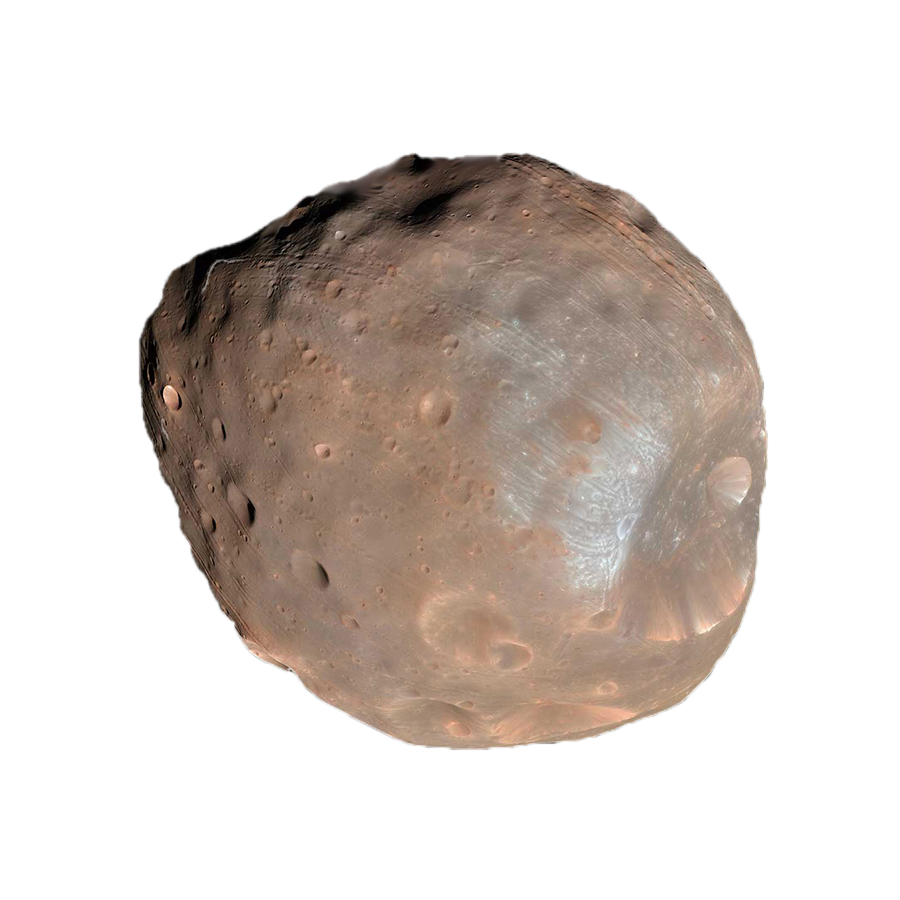
Waiting for a response, Dr. Chloe Kintaro stared out the station’s dome at the rust-colored prayer wheel of Mars swallowing half the vista,. The landscape sped by as Phobos circled the Martian equator every seven and a half hours, cycling rapidly from light and 25ºF to dark and -175ºF.
A meteorite had struck Phobos at an estimated forty kilometers per second. At the time Chloe was standing outside Limtoc station, playing the orbital frequencies of Phobos and Mars on her aluminum violin. Of course the violin made no audible sound in the vacuum of Phobos, but as Kepler had said, the ratios between planetary orbits created celestial music, audible not to the ear but to the soul.
The half-buried barnacles of Limtoc station were nestled down one end of the ancient nine kilometer Stickney crater. Its habitat modules and solar arrays, aged outposts of the first Mars mission base camp, had sustained damage from the quake following the meteorite’s impact. Everyone else evacuated, but the collision had exposed regolith preserving four billion years of Martian atmospheric ions. Chloe hadn’t been able to resist the lure of staying briefly to gather what she could of a unique archive.
But now, something else was happening.
— “Arcadia Planitia to Limtoc Station: You’re back in range Chloe.” It was James’ always welcome voice.
— “Limtoc to Arcadia: Hello James. Instruments are now picking up seismic traces that are not impact aftershocks. Regular pulses, coherent pressure waves with sharp electromagnetic transients. They’re driving standing acoustic waves. Synchronized with electromagnetic transients throughout Phobos.”
— “Arcadia to Limtoc. We’re monitoring that. And Chloe, the signals originate from the center of Stickney.”
— “Stickney!?”
— “We’re sending coordinates.”
— “I’ll go check.”
— “Quickly. The signals may be creating microscopic fractures within Phobos, As if something’s converting tidal energy into seismic waves, creating standing wave patterns of destructive interference at specific points. We’re theorizing a piezoelectric effect on targeted crystals in the soil structure. But… there’s no technology for that.”
— “A tuning fork struck against stone. Ringing the moon like a bell.”
— “A bell that may crack, Chloe. If the signals increase in intensity we’ll alert you to make an emergency evacuation. If propagation rates increase, Phobos will tear itself apart.”
Looking at the screens, the patterns reminded Chloe of Kepler’s Harmonices Mundi treatise and his ‘music of the spheres’. From a young age, with fired imagination she’d converted planetary orbital periods to audio frequencies for her violin, and later for synthesizer. Even now, watching from the observation dome as the Martian terrain sped by below, she had the “celestial music” of the solar system playing over the comms. And she took her worn copy of Harmonices Mundi with her, wherever she was stationed.
But now something on Phobos was playing the first bars of a funeral march.
The workstation chimed. Pulse frequency had jumped, and hairline cracks were now visible on monitoring cameras. The signals accelerated as the moon passed through tidal strain points in its orbit around Mars.
She overlaid the seismic data with orbital mechanics calculations. When Phobos made its closest approach to Mars, the pulses intensified. The moon’s tidal stresses were coinciding with the signals, creating a feedback loop accelerating the destruction.
Outside the station, handholds and tethers did the job Phobos’ gravity was too weak to do. One careless step could launch her into space at escape velocity, to become a tiny satellite of Mars’ tiny moon.
The EVA suit felt cumbersome after the station’s shirt-sleeve environment. The recycled air tasted stale, metallic. She loaded the rover with her toolkit, set its course, and sent it off across the dark gray dusty regolith.
The billions-year-old crater’s rim rose like broken mountain ranges around her, edges softened by eons of micrometeorite bombardment and dust accumulation.
Chloe fired her cold-gas thrusters in short bursts, traversing the crater floor in shallow, thirty-meter arcs of almost ten seconds each. She followed readings toward the epicenter of the signals, slipping past loose regolith and small rubble that rose up in slow-motion clouds. The helmet’s proximity alarms chimed as a house-sized rock slowly drifted past, barely curved by Phobos’s feeble gravity.
Precise triangulation of the signal source wasn’t necessary — there was a disturbed circle of regolith approximately ninety meters in diameter. Like a small crater well, Chloe stood at the low point at its center. The vibration was stronger here, a rhythmic pulse she felt through her boots. Grains of regolith danced across the area’s surface.
A garbled call came in from Arcadia – it must be going out of range. Chloe paused — had the voice sounded urgent? It was hard to tell through the static. Data streams from the seismic arrays showed increasing activity. She hesitated now over laying a shaped charge, not knowing how the signal source might respond, but she hadn’t the time for slow excavation. Laying the charge directly on the surface would disperse the jet after a relatively short distance, within meters, breaking into particles which would widen rather than deepen the hole. She set the smallest yield, and moved with the rover behind a house-sized boulder.
She triggered the charge.
A section of crater wall slumped, sending a slow motion cascade of regolith and rocks across the crater. As dust and particles hung in the air, she walked to the edge of the blast hole. Laid bare in the center was a curved metallic surface. It drank in her helmet lights. Through the dusty haze she could see patterns. She edged up to the exposed metal and brushed some of the dust away. Her breath caught: dark alloy inscribed with figures in sizes from meters to millimeters, in no form she’d ever seen. Geometric shapes, sequences… and what looked like orbital diagrams! The spacing, the repetition, the way certain glyphs appeared in grids or flanked by separator marks might indicate positional notation. What seemed to be ratios repeated: 1 : √2 : √3 : 2, Keplerian ratios, golden section, planetary resonance terms? The “equations” were rendered as geometric constructions, then beside them were symbolic forms.
Ground-penetrating radar indicated a shell roughly ninety meters in diameter. Was this structure as old as the crater? Was this what had created the crater? From within it came indications of increasing amounts of stored tidal energy as the pulse frequency climbed. Heat signatures bloomed across her infrared display, showing active power distribution at various points within the ancient metal.
Radiating lines and concentric circles on the surface of the object converged around a circular plate in the center. The surface was smooth, no pitting, no micrometeorite craters, no machining marks visible even under the cam’s 10x magnification. A hatchway? She pulled it upwards and it didn’t budge. She pulled sideways: clockwise it didn’t move in the slightest. But counterclockwise, the direction of planetary orbit, it turned smoothly, as if on oiled bearings. Chloe paused, then lifted the hatch. Her helmet lamp beamed down a shaft perhaps five meters long ending in another hatchway in the center.
She keyed the mic.
— “Limtoc to Arcadia: There’s a structure down here. There’s a shaft. I’m… I’m going in.”
Transmission crackled, then incoming signal came through again.
— “Arcadia to Limtoc:” She recognized Commander Parker’s voice. “Chloe, propagation rates of standing acoustic waves are increasing exponentially. At these rates Phobos won’t even wait for tidal forces to tear it apart. It’ll shatter from within. Get back to the station and evacuate. We’ll send a rescue ship to escort you back.
Chloe reviewed the seismometer arrays recording the tiny quakes and micro fractures that accompanied the accelerated stresses: tidal flexing, thermal expansion, micrometeorite impacts.
She looked down the shaft. It was an eight-sided vertical corridor approximately two meters in diameter. From each side short peg-like handholds stuck out. A blue light slowly brightened within the shaft, revealing walls inscribed with patterns, possible text, and various complexes of flat keys. What was powering the lighting system? Why was it still functioning after what must be ages?
— “Chloe, you have to leave now.”
That was James. She could hardly speak, her throat was constricted and her lungs were struggling to draw a breath.
— “James, this structure may … may have created Stickney crater… do you understand?”
There was a long pause.
— “Chloe, yes. I know you. But we can always come back.”
— “Not if the whole thing blows up. I’ll transmit as long as I can.”
— “Kintaro!” She recognized Commander Parker’s voice. “Evacuate now. That’s an order”
— “Commander. I’ll transmit visuals.”
Chloe was shaking so hard she could hardly turn on the transmission switch. She lowered herself into the shaft. Slowly, carefully. The metal gave off mild heat signatures and hummed with electromagnetic activity that made her fillings ache. Fine dust filtered down through the shaft in slow-motion clouds of gray.
She reached the lower hatchway, stood to one side and tried to turn it. New lights along the walls flickered and the upper hatchway snapped shut.
Chloe shivered. Trapped. Trapped. She could feel a faint thrumming through her feet and sensors indicated the near vacuum of Phobos being replaced with a gaseous mixture. An airlock. Okay, no trap, structure functioning as one would logically expect.. except… if it had formed Stickney, how was it still functioning after more than two billion years?
The hatchway at her feet slid out of view, revealing a shaft descending into darkness beyond the reach of her lights, until blue light brightened along its whole length. She started down, passing large lateral hatchways. The shaft continued down for perhaps forty meters before opening into a large chamber. When Chloe reached the floor, lighting strips activated.
Chloe’s breath caught at the engineering beauty of the place.
The walls were covered with screens displaying astronomical diagrams and orbital paths that shifted and updated, interspersed with intricate engravings on the metal of the walls. When she looked closely, she could see some engravings shifting form within the surface and sub-surface of the metal. Pale blue light illuminated eight corridors radiating out from the central chamber, stretching beyond her headlamp’s reach. At the center, a transparent cylindrical structure rose floor to ceiling.
Instruments filled the cylinder. Three-dimensional orbital displays showed current planetary positions, rotating in silent choreography. There were images of nebula, galaxies, galactic clusters. There were panels with figures, text, and diagrams scrolling sequences of symbols. If this was current information, from what source was this structure receiving it?
Chloe analyzed the cylinder materials: her device recognized titanium-vanadium alloys and rare-earth-doped ceramics, but many areas came up blank. Residual cosmogenic nuclides and helium-3/helium-4 ratios showed age variance between sections, The furthest back her device could calculate was five hundred million years, when Earth’s oceans were first teeming with complex life.
In several areas 3-D images played. Mars, marked with recent additions: human colonies, settlement zones, expansion areas. A planet surrounded by multiple moons. What looked like detailed calculations scrolling beneath. Then a sequence: impacts, debris fields, planetary surfaces scarred by bombardment. Cities being built, cities in ruins, outposts under hostile skies, dying stars. Engravings beside the displays changed in tandem with image changes.
The suit’s computer chimed. Data was streaming in across multiple bands, broadcast by the cylinder. She had no way of translating it, but let it be stored for future analysis.
Graphs flowed across some displays. Standing waves, nodes, interference focused at specific points within Phobos.
Her scanner detected piezoelectric cores embedded throughout the structure, perhaps drawing energy from tidal forces. Mechanical stress converted to electrical current, stored in some type of capacitor banks. Regolith shielding it all from radiation and micrometeorite impacts. Perhaps the recent impact had damaged calibration sensors, and the structure had reacted.
The corridors stretching out from the central chamber were alluring, but then there was a tremor throughout the structure. Phobos destabilizing further? She didn’t want to be buried in here.
But as she turned to leave, the standing-wave maps caught her eye again. One was an almost perfect inverse of the frequency ratios she had calculated for Phobos and turned into music for violin. Chloe hesitated, then, softly singing the notes she had created and played so often, she touched the panels beside the maps in the sequence she knew by heart: the major third, the perfect fifth, the octave.
The pulses wavered, slowed as the frequency slid downward. Then the whole chamber paused. Standing waves that had been shaking the moon apart began cancelling one another. Heat signatures faded across her visor.
Phobos seemed to settle beneath her. Chloe turned and ran for the shaft.
At the surface, she closed the hatchway and trekked back through a landscape showing signs of stress fractures spread across the crater floor. Dust and small rocks drifted from the rim. Cracks ran along the rim wall, glowing faintly in her infrared sensors, the moon’s interior slightly warmed through friction. The helmet’s display overlaid stress data on the terrain ahead. Hairline fractures spread through the surface, splitting and branching according to relationships that matched the seismic pulse sequences.
She fired her suit’s thrusters, moving in measured arcs. Above her, Mars dominated the sky, colony settlements across its surface, terraforming domes, mining rigs.
The research station appeared ahead, but her relief turned to panic as she saw the tilt of the modules. Several sections showed breach warnings, atmospheric integrity failing. She had maybe hours to prepare for escape, though the moon beneath her feet now felt… steady.
Chloe cycled through the airlock, her hands moving automatically through decontamination protocols. She set downloads of all the information her suit computer had gathered, and simultaneous transmission to Mars.
— “Limtoc to Arcadia . I’m back at the station. We’re stable, but station integrity is compromised. Prepping shuttle.”
— “Arcadia to Limtoc. Copy that. Phobos’ internal stresses are dropping quickly. What did you do?”
— “Limtoc to Arcadia. “I just sang the moon a celestial lullaby.”
She heard multiple laughs. She had an audience.
— “Arcadia to Limtoc. Time to end the concert and get out of there. There’s no guarantee aftershocks don’t crack Phobos like an egg. The rescue vessel is on its way.”
Chloe initiated emergency shutdown procedures for all sections of the station still functioning and prepared the tiny shuttle.
One minute.
The interface glitched from residual electromagnetic interference, before navigation trajectory data locked.
Thirty seconds.
She could feel Phobos steadying, but the research station, on the rim of Limtoc crater, had begun a twisting, very slow descent down towards the crater floor.
Fifteen seconds.
Mars rotated before her, cratered and ancient.
Ten seconds.
She felt station structural stress sending shudders fading through the floor of the shuttle.
Five seconds.
Trajectory calculations updated continuously, adjusting for real-time positions.
She fired the engines.
Nothing happened.
Chloe’s throat constricted. She checked all systems.. And checked again. She jumped out and did an external inspection. Everything was fine, everything… wait. Launch clamps had released, but the frame must have twisted slightly with the station’s subsidence. She tried pulling the clamps just a fraction farther apart. Station sections continued to twist and settle slowly down Limtoc crater’s slope. There would be no shelter left, no oxygen.
Phobos had stabilized, but there was no guarantee the buried structure might not start up standing waves again and finish the job, shattering the little moon, and her with it.
She paced. The life pod. She hauled it out of its bay and outside. They were halfway down Limtoc crater now. Not enough room for a takeoff. If she launched it from the top of the crater…
She loaded her violin and Harmonices Mundi into the pod, and the pod onto the rover. It was cumbersome but light in the microgravity. She drove up the side of Limtoc, to the wall of Stickney, and to the top of the crater. There was enough room for freefall, maybe, combined with firing the thrusters of the pod, to achieve pod liftoff.
Not even realizing she was yelling as she did so, she ran the pod off the crater edge, hopped in, and closed the hatch. She was gasping for air — her suit’s oxygen was low, and her panicked breathing had used it up faster. She hooked into the pod’s oxygen system. It should be charged… There was a pause then oxygen started to flow.
The pod’s computer made micro-adjustments, firing thrusters in bursts. She achieved a safe distance from Phobos.
For now the moon held along reinforced fracture lines. Small rocks and dust settled into trailing orbits. A chunk as large as a house drifted past, rotating slowly.
Her radio crackled.
— “Rescue ship Aurora is on the way.” It was James’ voice.
— “I’m in the emergency pod, keeping pace with Phobos. I’m transmitting all data recorded from the structure just in case…”
The pod sailed in tandem with Phobos. Waiting for the rescue ship, Chloe felt exhaustion catching up. Through the viewport, stars glittered and Mars turned, singing silent music of the spheres as the surface sped by: dust patterns, impact craters, mineral veins, settlements.
She put on the music she’d composed to sync with the cadences of the planetary orbits, and held close her worn copy of Harmonices Mundi. That ancient structure, buried for millennia beneath tiny Phobos, had responded to the orbital ratios Kepler first discovered for humanity, She murmured a passage she loved:
“The heavenly motions are nothing but a continuous song for several voices, to be perceived by the intellect, not the ear; a music which, through discordant tensions, through syncopations and cadenzas as it were, progresses toward certain predesigned six-voiced cadences, and thereby sets landmarks in the immeasurable flow of time.”
Kepler was right. The universe does sing. And across time and space, we can learn to hear its voice...
“Cadence”, © Mari Harrison, first published here in Cosmic Roots & Eldritch Shores, November 20, 2026
Honorable Mention, Kepler Award, 2025
Mari Harrison is an editor, longtime science and technical writer, and former neuroscience researcher. Her fiction has appeared in Nature: Futures, Apex Magazine, Book XI Journal, and elsewhere. Recent honors include winning the Ghost Story’s Supernatural Fiction Award and being named a finalist in both the Ploughshares Emerging Writers’ Contest and the Writers of the Future Contest. She lives in New England, where she writes stories that often ask what happens when we treat science and wonder as the same thing.
Author’s Note for The Kepler Award:
“Cadence”grew out of a long-standing fascination with the idea that the universe is not silent, only inaccessible to human senses. The concept of the “music of the spheres,” formalized by Johannes Kepler, suggests that orbital motion follows harmonic relationships in a precise, mathematical sense. I wanted to take that idea seriously and push it one step further: what if those relationships are not just descriptive, but functional?
The buried mechanism on Phobos is intentionally left unexplained. Whether it is a machine, a remnant of an intelligence, or something closer to a natural phenomenon shaped by deep time matters less than how it behaves. It responds to resonance, builds toward instability, and nearly destroys itself through feedback. In that sense, it mirrors many human systems: powerful, elegant, and dangerously sensitive to imbalance.
At its core, this story is about recognition—the moment when something vast and incomprehensible becomes partially legible. Chloe doesn’t decode the structure or uncover its purpose. She reaches a point of contact with it.
And that is the moment that matters.
Note: Stickney Crater is the largest crater on Mars’ moon Phobos, and is named after the mathematician Chloe Angeline Stickney Hall.
Illustration by Fran Eisemann, using public domain stock, courtesy NASA
You can comment on this story and artwork at The Forums, on our Twitter page, and our facebook page. and our blusky page
You can Subscribe to one of our sliding scale subscriptions to receive notifications of future publications, and to help us bring you more stories, artwork, podcasts, and articles.