

Nosferatu (2024): Post-Mortem of a Shadow Reborn
Tara Grímravn
Hello, little shade.
Tonight, we lift the lid from the coffin of a creature that has haunted human imagination for millennia in numerous forms. Once, in ancient times, it was a thing of graveyard shadow and roadside dread. Communities developed precise ritual practices to protect the living from strigoi, lilitu, vetalas, vrykolakas, and other revenants. In more recent centuries, the vampire proved a popular subject in both literature and fireside folktales. And, of course, over the last hundred years, it has clawed its way into the heart of cinema-goers everywhere.
Should you be among those who enjoy horror, as I do, then what lies within the sarcophagus is already familiar.
Nosferatu has risen once again on the silver screen, this latest summoning conjured by American film maker Robert Eggers. In this vision, the shadows of Stoker, Murnau, and Coppola loom… and yet, this newly unearthed corpse offers only echoes.
In 1897, Bram Stoker gave us hunger disguised as desire: a predator who penetrates the soul, dissolving boundaries with every bite. His inspiration was based in genuine history: the infamous Vlad III, Prince of Wallachia. The prince’s moniker, Dracula, a diminutive meaning “son of the dragon” thanks to his father’s induction into the chivalric Order of the Dragon in 1431, now reduced to a literary trope.
Later, in 1922, Murnau distilled both Stoker and centuries of Slavic vampire lore into silhouette, plague, and shadow. Orlok’s presence curls the air itself. Though numerous films and books were written and recorded over the next century, one of the most well-known came from Coppola in 1992, Bram Stoker’s Dracula. This film draped Dracula in velvet and fever, every scene dripping in opera and lust entwined with dread.
Every iteration of the legend has left a mark. Each conjured fear that lingered.
Eggers’ film attempts to inherit these legacies. It strives for dread, intimacy, and the weight of history. And yet, though aesthetically pleasing and wonderfully atmospheric, it fails on a fundamental level.
Bill Skarsgård’s Orlok is visually striking, yes, but empty. The creature’s menace exists only in shape and gesture, the soul behind the mask entirely absent. Orlok’s character here is a faded silhouette when compared to Max Schrek’s alien-like presence. The viral nature of his cursed, perpetual hunger never reaches beyond the screen, never truly touches the audience.
Ellen, played by Lily-Rose Depp, is neither a tether nor a conduit of terror or desire. Instead, she is little more than ornament, a figure in a tableau, never a force that binds. She lacks the willful modernity of Mina Harker and the hypnotic fragility of Isabella Adjani, becoming instead a specter in a nightgown, a plot device given form.
The cinematography is precise. The frames are meticulous, the palette is cadaverous, the silence dense. But these are bones without a body: craft without bite. Eggers sculpts atmosphere, yes, but atmosphere alone does not feed that which hungers in darkness. He merely assembles the echoes of past legends, and we, the audience, watch shadows mimic shadows on screen.
Nosferatu (2024) is beautiful but vacant, a vampire without thirst, a resurrection without pulse. It borrows, parades, and recycles the familiar, yet adds nothing new to the myth. True, the ritual is performed perfectly, and audiences will immediately recognize the story and premise… yet nothing answers. No terror blooms, no fascination lingers. No dark god appears on stage once the summoning is complete.
One might argue that this is deliberate, a return to the folkloric essence of the vampire as pestilence. However, while such an endeavor is worthy of praise and applause, the film never fully achieves this goal. The terror is never fully realized, the dread never truly brought to life.
The specter within this sepulcher is hollow, perfumed, polished, a shimmering reflection of all that came before it. But if you seek a fresh bite of true horror or an infusion of new blood into the vampire mythos, there are far richer graves to plunder.
I expected revival, a fresh vision of terror rooted in ancient lore, but was greeted with little more than a meticulously preserved corpse.
Though Stoker’s words still bleed, Murnau’s shadows still stain the skin, and Coppola’s velvet still writhes, Eggers offers only their corpse. Dressed to impress in visual finery, it never reaches back far enough to pull the pestilent rot from the graves it purports to resurrect. It is a masterpiece of the mortician’s art, permitting the audience to view little more than a perfect, and perfectly lifeless, effigy of its predecessors.
“Nosferatu (2024): Post-Mortem of a Shadow Reborn”, © Tara Grinravn, first published here in Cosmic Roots & Eldritch Shores on October 28, 2026
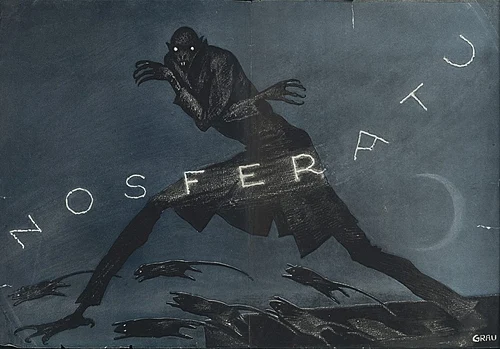
End pic: Nosferatu poster, Albin Grau, 1922; “Nocturnal Whisperings” and “Mystical Forest” background by Wyldraven, who can be found roosting here amongst much beautiful artwork.
You can comment on this poem and artwork at The Forums, on our Twitter page, and our facebook page. and our blusky page
You can Subscribe to one of our sliding scale subscriptions to receive notifications of future publications, and to help us bring you more stories, artwork, podcasts, and articles.
